
Common Problems in Welding Process and Solutions to Resolve Them
Welding is a popular metal fabrication process employed for joining two pieces of metal or thermoplastic materials. There are several modern welding techniques used in industrial metal fabrications. MIG, TIG, GTAW, SMAW, etc are commonly used welding techniques. These techniques are quite simplified by using sophisticated equipment and also offer quick welding. However, due to the speed and ease offered by these modern welding techniques, the operators often neglect basic essential steps of the welding process. This leads to several problems in the welding joint. The problematic welding joints can cause the abrupt failure of fabricated systems, reduction in joint strength, etc. These problems can be fatal in cases of extremity, especially when welding is performed for massive industrial products like pressure vessels, storage tanks, etc. Therefore, the solutions to such problems must be found. This post discusses common problems that occur in defective welding and solutions to resolve them.
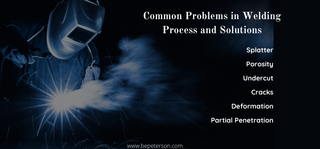
Commonly Occurring Welding Problems and Their Solutions
The following are some problems that occur frequently in the welding process, let us discuss their solutions too.
1. Splatter: The problem of splattering specifically occurs in the gas metal arc welding process (GMAW). This can be noticed when droplets of molten metal splatter on the workpiece surface, which further causes surface contamination, slag inclusion, or weld-interruption. Splattering occurs due to high welding flux flow, insufficient shielding, or incorrect polarity.
Solution: As a solution, the operator should keep low welding flux flow or current, ensure the polarity of the consumable electrode. In addition, cleaning the nozzle, increase in torch-to-plate angle, and selecting flux flow according to the type of shielding gas is proven helpful in the reduction of splatter.
2. Porosity: Porosity occurs due to the absorption of air, nitrogen, hydrogen, oxygen, etc in the molten weld pool. Entrapped gas molecules cause gas bubbles and hotspots on the welding joint leading to porosity. Porosity weakens the weld strength, also contamination of oil, dust, and moistures take place in porous holes.
Solution: To prevent porosity, the welder should re-bake the consumable electrode. Avoiding welding torch leakage and inappropriate torch-to-plate angle is proven helpful. The torch-to-plate angle must be maintained in medium size, which means it should not be too small or too large.
3. Undercut: Undercut is solely the welder’s fault. It occurs due to the selection of too long welding electrode, too fast welding speed, and high arc voltage.
Solution: To avoid undercuts, the welder must keep the arc voltage under limits, should use the electrode of appropriate size and must practice slow welding.
4. Cracks: They can occur during machining processes or during welding. If preheating or spot heating before welding is skipped by the welder, there are chances of cracks in the metal. Small cracks may enlarge with time. During welding, just filling cracks with filler metal does not suffice, therefore cracks must be prevented.
Solution: To prevent cracks in welding, metal preheating or spots must be done. Grinding, filing, deburring, etc must be done to level the crack with a metal surface.
5. Deformation: Deformation happens post welding. It occurs during hardening or cooling of the weld as with dropping temperature the metal contracts. The contraction occurs along the flow lines formed during welding. It can also occur due to incorrect welding sequence, multiple welding filler layers, or poor clamping.
Solution: To avoid permanent deformation, flow lines must be reduced. To do so, the center-out direction of the weld must be performed. Also, changing the weld sequence and slow cooling is proven helpful in avoiding deformation.
6. Partial Penetration: Partial penetration occurs due to incomplete root fusion. If the root gap is not filled with filler material from one root end to another, partial penetration occurs.
Solution: To avoid partial penetration, the root gap so that filler material gets more space to penetrate. The size of the consumable electrode can be reduced so that the filler material enters the gap easily.
Metal fabricators or metal product manufacturers must pay attention to these problems and should opt for proper solutions. This can help in the reduction of failure potential. While sourcing metal fabrication or precisely welding services, you must partner with a manufacturer that pays attention to problem resolution and quality enhancement. BEPeterson is a company that offers high-quality welding services for products like pressure vessels, storage tanks, etc. The company is ISO 9001:2015 certified and compliments welding services with inspection techniques like x-ray inspection, surface crack, and inclusion detection tests in compliance with ASME and ANSI standards.


