Everything about the Pressure Vessels Head Types
Pressure vessels are an integral part of industrial equipment. According to the American Standard of Mechanical Engineers’ (ASME’s) boiler and pressure vessel code (BVPC), pressure vessels are industrial equipment for storage of pressurized fluids. Since the pressure vessels are exposed to immense internal and external pressure, the construction of these vessels play an important role in industrial safety. The pressure vessel construction has to be compliant with the ASME codes. Do all ASME pressure vessels act the same? Not exactly. They act differently due to the variations in their designs. The head types are one such feature that differs across pressure vessels. This post gives insights into the significance of pressure vessel heads, and different vessel head types.
Significance of Pressure Vessel Heads
The pressure vessel head is an important design and construction parameter in the pressure vessel design. Why so? The following pointers will explain it better.
· Pressure Sustainability: Different vessel head types offer different ranges of pressure tolerance. The pressure vessels and heads are designed to accommodate only a specific range of pressure, therefore, exposure to higher or significantly lower pressure can cause damage to the pressure vessel assembly.
· Local Stresses: Different pressure vessel types are exposed to multiple local stresses. These local stresses may include bending stresses, stresses due to internal pressure fluctuations, stresses exerted on the vessel walls, etc.
· Manufacturing Cycle: The types of pressure heads impact the manufacturing and installation cycles of the pressure vessel assemblies. The manufacturing times will differ according to the complexities involved in the design.
Different Types of Pressure Vessel Heads
The following are the types of pressure vessel heads.
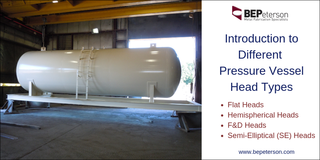
· Flat Heads: As the name suggests, the inner section of these types of heads is flat. However, the top surface of these types of the head may be curved slightly to overcome bending stresses due to pressure. This is the least utilized type of pressure vessel type. They are used for low or no-pressure-sustaining vessels. These vessel head types are suitable for storage tanks where internally no or minimal pressure is exerted by the material stored inside the pressure vessel.
· Hemispherical Heads: These types of pressure vessel heads feature a hemispherical dome structure. This is a highly effective type of pressure vessel heads as the pressure distribution across the hemispherical cross-section is effective. These vessel head types are considered the strongest pressure vessel heads with utmost endurance. These pressure vessel heads can endure pressure twice the capacity of torispherical heads at the same thickness and other dimensional parameters. However, the manufacturing of hemispherical heads takes extra forging efforts and may involve expensive procedures to manufacture thin yet highly enduring heads.
· Flange and Dished (F&D)/ Torispherical Heads: The torispherical vessel head types feature a torispherical shape. This special design consists of a part of a torus and a part of a sphere, which are coalesced to form a torispherical structure of a pressure vessel head. These pressure vessel heads are specifically designed for cylindrical pressure vessel types. Although the shape of these vessel head types resembles the ellipsoidal heads, the minor difference in shape makes these heads easy to forge or manufacture. These vessel head types are preferred for pressure vessels containing lesser than 10bar. Construction of these heads above that pressure may become uneconomical due to requirements of the transition section to cope with excessive stresses.
Generally, according to the ASME code, the head-to-shell circumferential ratio is managed at 3:1 in these types of vessel head constructions.
Two common types of torispherical heads are popular in the industry. The types of torispherical heads are listed below.
o Klӧpper heads: In this type of torispherical head, the radius of the head remains equal to the radius of the cylinder whereas the knuckle radius remains 1/10th of the cylinder radius.
o Korbbogen heads: According to DIN 28013, these are the torispherical heads with the head radius equal to 80% of the cylinder head i.e.; head/dish radius= 0.8 x diameter of the cylinder. Whereas, the knuckle radius = 0.154 x diameter of the cylinder. The Korbbogen heads are also known as semi-ellipsoidal heads.
· Ellipsoidal Heads: The semi-elliptical heads feature an elliptical construction with a gradually increasing radius. The major axis to minor axis ratio remains 2:1 in these vessel heads. This construction eases the transition between the head and cylindrical top of the pressure vessel. Commonly, these vessel head types are designed for greater than 10bar of pressure. The cost of construction is considerably low in these vessel head types due to dish-like shallow depth structures.
NOTE: The ellipsoidal heads can also be called semi-elliptical pressure vessel heads, where multiple ratios of major to the minor axis can be adopted to customize the depth and circumferential area of the head. However, these variations in the ratio are rare due to the high-efficiency of the 2:1 ratio.
With an understanding of the significance of pressure vessel heads and different vessel heads, it is essential to focus on the quality of production. In order to ensure the quality of pressure vessels, it is essential to partner with a manufacturer specializing in ASME and non-ASME pressure vessel manufacturing. Also, ensure that the manufacturer offers in-house and third-party testing and quality control services to ensure the best possible quality and performance efficiency of the pressure vessel heads