
Your Phone Remembers Where You Left Off, and That Changed Everything
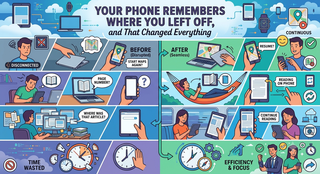
Start a show on your phone during lunch. Pick it back up on the television that evening without touching a single setting. It sounds unremarkable now, almost too obvious to mention, but that quiet continuity represents one of the more significant shifts in how digital products get built. A decade ago, that same simple act would have meant starting over, or at best hunting through menus trying to find your place again.
The old model of entertainment tied you to a device. Games lived on a desktop. Movies lived on a television. Browsing lived wherever you happened to be sitting with a laptop open. Those boundaries have mostly dissolved, and the dissolving happened quietly enough that most users never noticed the moment it became normal. They just started expecting it.
That expectation is now the baseline, not the exception, and understanding why says a lot about where digital entertainment goes from here.
The Single-Device Era Is Officially Over
For most of the internet's early history, moving between devices meant losing something. Progress, preferences, half-finished conversations, all of it tended to stay locked to whatever screen you'd been using.
That friction used to be tolerated because there wasn't much alternative. Now it reads as a design failure. Modern users move between a phone on the train, a laptop at a desk, and a tablet on the couch without a second thought, and they expect every one of those transitions to feel invisible. A service that forces someone to manually re-sync their progress or relearn a different interface on each device is quietly telling that person to look elsewhere.
Cross-platform compatibility has consequently stopped being a nice bonus tucked into a premium tier. It's become table stakes, the unglamorous baseline every serious product needs just to stay in the conversation.
Consumer Habits Reshaped the Whole Day, Not Just the Screen
What's changed isn't only which device people reach for. It's when and where they choose to engage with entertainment at all, and that shift has quietly rewritten product design from the ground up.
A commute might mean skimming articles on a phone. An evening might mean settling into a larger screen for something more immersive. A quiet stretch between tasks might mean checking in briefly with an online community. Each of these moments used to belong to a different device by necessity. Now they belong to whichever device happens to be closest, because the underlying service is expected to keep up regardless.
Consumers rarely think consciously about the infrastructure making this possible. They simply expect a platform to remember their preferences, carry their progress forward, and feel familiar no matter where they log back in. Businesses that understand this pattern tend to see it show up directly in customer satisfaction, because every bit of friction removed from a transition is one less reason for a user to get frustrated and drift toward a competitor.
Mobile Stopped Being the Backup Plan
For years, the desktop computer held the default position as the primary way people accessed digital entertainment. Mobile was the convenient afterthought, useful in a pinch but rarely the main event.
That hierarchy has fully inverted. Smartphones are now the first, and often only, gateway to digital entertainment for a huge share of users worldwide. Faster processors, better connectivity, and increasingly capable browser technology have all conspired to make a phone genuinely sufficient for experiences that used to demand dedicated hardware.
Why This Reordering Actually Matters
The consequence isn't just a statistic about device usage. It's a fundamental shift in how products get designed from the very first sketch. Developers building with a desktop-first mindset and treating mobile as an afterthought now risk designing for a shrinking share of their actual audience. The smarter approach flips that order entirely, designing for the smallest screen first and scaling upward from there, because that's genuinely where most of the engagement now lives.
This isn't a temporary trend either. As mobile hardware keeps closing the performance gap with desktop machines, the case for treating phones as a secondary platform keeps getting weaker.
Consistency Is Doing More Work Than People Realize
There's a reason consistency across devices gets treated as such a big deal by product teams, even though users rarely articulate it directly. It's one of the fastest ways to either build or destroy trust.
When someone switches from one device to another, they expect the interface to feel familiar, their settings to carry over, and their content to be waiting exactly where they left it. Even small inconsistencies- a setting that didn't sync, a layout that behaves differently on one screen than another- create a disproportionate amount of frustration relative to how minor the glitch actually is. People don't experience these as small technical hiccups. They experience them as evidence the product can't quite be trusted.
Platforms that get this right benefit twice over. Engagement tends to rise because users spend less energy relearning an interface and more time actually enjoying the content. And brand recognition strengthens too, since a genuinely consistent experience is far easier to describe to a friend than one that behaves differently depending on which device you happen to be holding.
The Technology Quietly Making This Possible
None of this seamless movement between devices happens by accident. It's the product of steady, largely invisible improvements in how the web itself works.
Responsive layouts, cloud-based synchronization, and HTML5-driven applications have collectively closed most of the gap that used to separate a desktop experience from a mobile one. Rather than building entirely separate versions of a product for each platform, a single well-built application can now adapt itself automatically to whatever screen it lands on.
The business case here is straightforward. Lower development costs on one side, broader accessibility on the other. Fewer resources spent maintaining parallel codebases means more resources available for the parts of the product that users actually notice and care about.
Communities Move With Their Members
Online communities have quietly become one of the biggest beneficiaries of this shift toward device flexibility, even if the connection isn't always obvious at first glance.
A conversation that starts on a phone during a lunch break can pick right back up later from a desktop without losing any momentum or context. That continuity matters more than it might seem, because community engagement tends to depend heavily on low-friction participation. The easier it is to jump back into a discussion from whatever device happens to be nearby, the more likely people are to actually stay engaged over the long run rather than drifting away after a single missed session.
This flexibility has effectively untethered communities from both location and hardware, which partly explains why so many online groups now feel more active and persistent than their equivalents from a decade ago.
Everything Is Becoming One Connected Ecosystem
Streaming services, creative tools, educational platforms, and interactive experiences all share a common underlying goal these days, whether or not the companies building them describe it in those terms. They're trying to reduce the distance between a user and whatever they actually want to do.
Rather than designing a product around a single device, the more common approach now is building an ecosystem where preferences, progress, and content travel with the person rather than staying pinned to a particular screen. That reflects a genuinely broader change in consumer behavior. People increasingly expect digital services to fit into the natural rhythm of their day rather than asking them to rearrange their day around the service.
Industry observers tracking the broader evolution of digital gaming platforms have pointed out how this kind of cross-device accessibility is actively reshaping user expectations, encouraging noticeably smoother experiences across regions with very different technical infrastructure and very different habits around when and how people play.
Regional Patterns Are Shaping Global Strategy
Technology adoption never looks identical everywhere, and some of the most interesting innovation in cross-platform design has come out of markets that don't get discussed as often as they should.
Southeast Asia stands out as a particularly instructive case. Widespread smartphone adoption across the region, often ahead of desktop penetration rather than following it, has created sustained demand for lightweight applications that perform reliably across a genuinely wide range of devices and internet conditions. Developers responding to that market have leaned hard into mobile-first design principles and careful attention to performance under less-than-ideal connectivity, out of necessity rather than trend-chasing.
That regional pressure has ended up influencing global product strategy more than people might expect. Research examining shifting entertainment habits in Southeast Asia consistently points to mobile connectivity, changing consumer preferences, and steadily improving digital infrastructure as forces reshaping online experiences across an unusually wide range of industries, not just gaming. Lessons learned building for markets where a phone is often someone's only device tend to translate remarkably well everywhere else too.
Where This Goes From Here
Cross-platform experience has moved well past being a nice convenience. It's become one of the defining expectations shaping how people interact with digital services on a daily basis, and that expectation only seems to be intensifying.
Faster synchronization across an even wider range of connected devices
Deeper personalization that follows users automatically, without manual setup
Continued narrowing of the gap between mobile and desktop capability
Growing influence from markets where mobile has always come first
Businesses that take these expectations seriously tend to build the kind of lasting relationships with their audience that survive the occasional rough update. The ones still designing around a single primary device are increasingly building for an audience that's already moved on.
The Bigger Picture
Success in digital entertainment was never really about perfecting a single screen. It's about building something that feels intuitive, connected, and genuinely accessible no matter which device a person happens to reach for in any given moment.
The technology behind that shift- cloud synchronization, responsive design, increasingly capable mobile hardware- will keep quietly improving in the background. What won't change is the underlying expectation driving all of it: people want their entertainment to follow them, not the other way around. Companies that internalize that simple idea are the ones building products people actually stay loyal to.


