Six Techniques That Make Your Proteomics Research Easier
iTRAQ, TMT, and the non-labeled quantification technique Label-free are undoubtedly the most popular proteomic labeling techniques in recent years, which take up half of the quantitative proteomics market. Mass spectrometry has successfully mapped and quantified protein atlas for multiple species with its characteristics of stability, accuracy and efficiency. It has been widely used in biology and medicine, providing an effective means for finding molecular markers and drug targets.

While, how much do you know about real quantitative proteomics techniques?
Quantitative proteomics is divided into relative quantification and absolute quantification depending on different purposes. The purpose of relative quantification is to find differentially expressed proteins in samples under different conditions, which is often used in exploratory experiments to obtain molecular markers of interest. The main technical means are iTRAQ/TMT, SILAC, Label-free and SWATH. The purpose of absolute quantification is to qualitatively and quantitatively analyze the target protein, which is often used in confirmatory experiments. The main technical methods are MRM and PRM.
Firstly, let’s get to know the most popular techniques, iTRAQ and TMT.
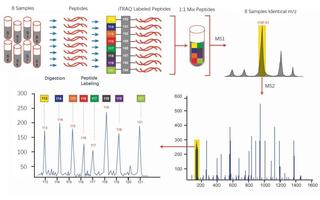
Both iTRAQ (Isobaric Tags for Relative and Absolute Quantitation) and TMT (Tandem Mass Tags) are quantitative proteomic in vitro labeling techniques, and the principles of the two are basically the same, completing the labeling of the peptides by the reaction between labeled reagents and the N-terminus or lysine side chain of the peptide. The labeled peptides are detected by tandem mass spectrometry (LC-MS/MS) to simultaneously perform protein identification and quantification on multiple sets of samples.
The differences are that they are developed by different companies and the number of tags is different. iTRAQ, developed by AB Sciex in 2004, is suitable for QTOF series mass spectrometers. It can mark and qualitatively and quantitatively analyze 8 samples at a time. Later on, Thermo introduced TMT that can mark up to 10 samples. While, because of its high requirements for mass spectrometers, it is only suitable for Orbitrap series mass spectrometers with ultra-high resolution. These two label quantification methods do not depend on samples, and can label almost any protein in the sample, and detect lower abundance proteins, cytoplasmic proteins, membrane proteins, nuclear proteins, extracellular proteins, etc., and are quantitatively accurate as well. They are especially suitable for differential protein analysis using multiple treatments or samples from multiple treatment times.
Compared with in vitro labeling, the principle of SILAC (Stable Isotope Labeling with Amino acids in Cell Culture) is based on in vivo labeling: replacing the corresponding amino acids in cell culture medium with essential amino acids labeled with natural isotope (light) or stable isotope (heavy). . The lysed proteins of different labeled cells are mixed in the same proportion as the number of cells or the amount of protein. After isolation and purification, mass spectrometry is performed. This method is based on the incorporation of markers in cell culture, which makes the sample closer to the real state, reduces the experiment errors, makes the quantification more accurate, and provides an effective means for solving the quantitative analysis of complex mammalian cell proteome.