
Maldives Honeymoon Planning: Notes on Beginning Marriage
There is something clarifying about arriving at a place that exists barely above sea level. The Maldives rises from the Indian Ocean like an afterthought—1,192 islands scattered across 90,000 square kilometres of water, most of them uninhabited, many of them unnamed. Your seaplane descends, and you find yourself looking down at what appears to be a watercolour someone hasn't finished: lagoons the colour of pale jade bleeding into deeper blues, sandbars that seem to shift even as you watch them. This, you think, is where honeymoons come to take themselves seriously.
I have always believed that the best travel begins with intention. Not a rigid itinerary—those are for anxious people who confuse motion with progress—but a clear sense of why you're going somewhere in the first place. Maldives honeymoon planning requires this intention more than most destinations, because the islands offer something increasingly rare: genuine isolation. You will be alone together in ways that modern life rarely permits. The question is whether you're ready for that.
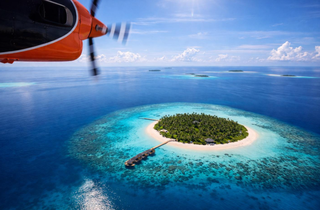
Caption: From the seaplane, each island appears as its own small universe—a ring of sand, a crown of palms, and that improbable blue stretching toward every horizon.
The Geography of Intimacy
The Maldives is organised into 26 atolls, which are themselves organised into tourist regions that the government has designated with varying degrees of access and exclusivity. The geography matters more than you might expect. North Malé Atoll sits closest to the international airport—a twenty-minute speedboat ride to some resorts, which appeals to couples who dislike small aircraft or who arrive exhausted from long-haul flights. The more distant atolls—Baa, Lhaviyani, Dhaalu, Noonu—require seaplane transfers that add ninety minutes of travel but subtract something harder to quantify: the lingering sense that civilisation waits just over the horizon.
I would choose distance. A honeymoon is not a weekend break. You have presumably spent months, perhaps years, surrounded by wedding logistics, family opinions, and the peculiar stress of organising a public ceremony to mark a private commitment. The Maldives offers recovery from all that, but only if you let the ocean create actual separation. There is a difference between feeling remote and being remote. The distant atolls provide the latter.
For couples beginning their Maldives honeymoon planning, I recommend the comprehensive Maldives Honeymoon Planning Guide as a starting framework—it addresses the practical questions (transfers, budgets, timing) that must be settled before the romantic ones.
On the Question of Villas
Every resort offers variations on the same essential choice: beach villa or overwater villa. The overwater bungalow has become the defining image of Maldivian tourism, and there are good reasons for this. You wake to the sound of water moving beneath your floor. You can slip from your deck into the lagoon without encountering another soul. At night, the darkness is absolute, and you understand why ancient sailors believed they might fall off the edge of the world.
But the beach villas have their own argument. Sand between your toes at three in the morning. The rustle of palm fronds in the wind. A garden that provides the illusion of privacy even on a small island. Some couples rotate—three nights over water, three nights on land—treating the change as a small adventure within the larger one.
Caption: The overwater villa at dusk: your private deck becomes a front-row seat to the Maldives' nightly performance of colour and silence.
The honest answer is that either choice works, provided you've chosen well on everything else. Villa category matters less than reef quality, house reef accessibility, resort atmosphere, and—this is crucial—the ratio of villas to island size. An island with twelve villas feels different from an island with two hundred. Both exist. Know which you're booking.
Timing and the Monsoon Question
The Maldives has two seasons, and travel writers have spilled considerable ink trying to make this simple fact sound complicated. The northeast monsoon (December through April) brings dry weather, calm seas, and premium prices. The southwest monsoon (May through November) brings occasional rain, better diving visibility on certain atolls, and rates that drop by thirty to fifty percent.
I have visited tropical destinations in their "off seasons" and found them superior to their marketed peak months. Fewer tourists. Staff with time to remember your name. Rain that arrives dramatically, passes quickly, and leaves the air feeling washed. The Maldives in September is not the Maldives in December, but the difference is not what the brochures suggest. For couples whose Maldives honeymoon planning includes budget consciousness—and it should, since the savings can fund an extra three nights—the shoulder months deserve serious consideration.
What matters more than season is duration. A four-night honeymoon in the Maldives feels rushed. You spend the first day recovering from travel, the last day dreading departure, and the middle two wondering why you didn't book longer. Seven nights is the minimum for genuine decompression. Ten nights is better. Two weeks is ideal, though few couples can manage it.
The Reef and What Lives There
A curious thing happens to honeymooners who snorkel for the first time over a healthy Maldivian reef. The underwater world renders conversation impossible, which means you experience wonder in parallel rather than together—floating side by side, pointing at the same parrotfish, surfacing to exchange fragments of description before diving again. It is a shared solitude, if such a thing exists. Marriage will contain many such moments: parallel lives that touch and separate and touch again.
Caption: The house reef becomes a private aquarium—no boat rides, no schedules, just the two of you and whatever the ocean decides to reveal.
The house reef—the coral formation directly accessible from your resort's beach—varies dramatically between islands. Some resorts sit on sand flats where you must boat to decent snorkelling. Others drop immediately into reef walls alive with sharks, rays, and turtles. If marine life matters to you (and it should, because you're travelling to an archipelago nation composed almost entirely of ocean), research reef quality before booking. Ask direct questions. Request recent guest photos. The resort's marketing will always promise abundant marine life; the reality requires verification.
For understanding the full scope of what the Maldives offers—beyond the honeymoon-specific considerations—the Ultimate Guide to the Maldives provides essential context on atolls, activities, and what makes each region distinctive.
What You Will Eat
Resort dining in the Maldives follows a predictable pattern: one fine-dining restaurant with an international chef, one casual beachfront venue, one overwater specialty restaurant (usually Japanese or seafood), and a breakfast buffet substantial enough to discourage lunch. The food is rarely exceptional—supply chain limitations on remote islands make culinary creativity difficult—but it is consistently good, and the settings compensate for what the kitchens cannot quite deliver.
Full-board or all-inclusive packages make financial sense in the Maldives because alternatives don't exist. You cannot stroll to a neighbourhood restaurant. You cannot comparison-shop between competing cafés. You are captive to your resort's kitchens, and the resorts price accordingly. Factor this into your planning. A resort quoting lower room rates may charge more for meals; the total cost is what matters.
Caption: Dinner on the sand, lantern-lit and private—the Maldives specialises in orchestrating moments that feel spontaneous but require considerable logistics.
A Final Reflection on Beginning
Marriage is, among other things, an agreement to see the world together. Not always literally—life requires separate errands, solo commutes, time apart—but fundamentally, metaphysically. You are choosing a permanent travel companion. The Maldives makes this explicit in ways that other honeymoon destinations obscure. There is nowhere to go except to each other. The island is small. The ocean is large. You float in it together, eat together, watch the same sunset from the same deck, fall asleep to the same sound of water.
This is either wonderful or terrifying, depending on the marriage.
Maldives honeymoon planning, done properly, accounts for this intensity. Choose a resort with enough space to breathe separately when breathing separately is needed. Book a duration long enough to move past the performative phase of honeymoon behaviour into something more genuine. Select activities that match your actual interests rather than Instagram's expectations. And remember that the point of travelling so far—across time zones, over oceans, to islands that will someday disappear beneath rising seas—is not to collect experiences but to begin the long process of experiencing things as two people who have chosen each other.
The Maldives will not fix anything broken or improve anything mediocre. But for couples beginning well, beginning clear-eyed, beginning with the intention to pay attention—to each other, to the impossible blue, to the reef shark circling at dawn—there is no finer place to start.

